
On Christmas 1981 I "found" a Metz 45 CT-1 under the tree. It was no surprise as the Christmas money from parents, grandparents and relatives was pooled for the purchase. WOW! Compared with my earlier Revuetron I felt that I had just switched from a bullock cart to Mercedes S-Class. (In 1981 I had not ever driven in either, but I can still quite strongly remember the joy of the moment.)
The 45 had been unveiled at Photokina 1976 and had become an instant success becoming the workhorse of many pro's and amateurs.

- It had amazing power for the day (and still today see below) with a GN of 45 while illuminating a 35mm lens field of view.
- The reflector could be swiveled and turned 90/360.

- It had amazing power for the day (and still today see below) with a GN of 45 while illuminating a 35mm lens field of view.
- The reflector could be swiveled and turned 90/360.
- It offered automatic flash for five apertures.
- The automatic worked for all cameras and lenses of the day (unlike CAT)
- It had a built quality to match the pro cameras of its day. My 45 still works and works and works after hard and long use in 29 years.
- It had a large range of system accessories (which will be explained later in more detail).
Like everyone I was simply drooling for it as a youngster and happy like squirrel when I got it.
How did it work?
The "computerised" electronic flash as it was often called in marketing language at the time even though there was no computer involved was pioneered by the famous Vivitar 285 Model.
The simple manual electronic flashes like Revuetron had basically three components: A battery connected to a capacitor connected to the flash bulb. The connection between capacitor and flash bulb was through the connectors in the hot shoe. (Hence the often high voltage.)
A capacitor can be compared to an electronic toilet tank: The voltage from the battery slowly but steadily charges the capacitor like a stream of water. Once it is full, It stops charging. The voltage when fully charged can reach high amounts and in earlier simpler designs this high voltage might be connected to the hotshoe as explained here. As soon as the circuit between flashbulb and capacitor is closed all the stored energy drains out in one go, like pressing the button on the toilet tank.
In earlier manual flash designs like Revuetron or ED the full charge was always fully drained. And then a new re-charging cycle started, taking minutes.
The automated models added basically two more elements: A light sensor and an electronic switch (a so called thyristor) between capacitor and flashbulb. Now closing the hot shoe or cable contacts switched the thyristor "on" which in turn let the high voltage get to the flashbulb. The light sensor measured the light reflected back to the flash and after receiving sufficient light switched the thyristor "off". The whole thing works because thyristors can handle high voltages and they are very, very fast switches.(Computer chips are built up with tiny thyristors that can switch more than a billion times per second.)
There are two brilliant effects with this design, first and foremost that of flash automation, second because only part of the capacitors charge is used before it is switched off by the thyristor, "there is water left in the tank" and the recharging is much quicker!
Why was the 45 a quantum leap?
Earlier automated flash models or cheaper ones had only a limited range of apertures to choose from. The majority of models had one or two apertures to choose from. The apertures you could choose depended on the ISO of the Film used.
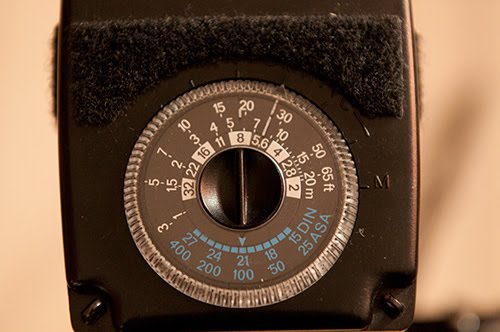
The 45 gave you a choice of five apertures after selecting the ISO. The inner Dial on top was used to select ISO of your film. The outer transparent wheel could be turned to one of five aperture positions or Manual. The scale below the transparent wheel showed the selectable apertures and maximum distance for your selected aperture. The full charge of the capacitor is used when the indicated maximum distance is reached. The flash duration is between 1/300s to about 1/25000s. The minimum distance is between 0.5m and 1.5m depending on the selected aperture.
In the picture above you can see, that with ISO 100 selecting 2.8 as aperture results in an automatic working distance between 1.5m to 16m. The selected 5.6 (to get a bit Depth of Field) has a working distance from 0.7 m to 8m.
The workflow was
1) Select ISO and aperture on the flash (as per picture above)

2) Set camera to desired time of 1/125 or lower and to the selected aperture.
3) Aim at something between minimum and maximum distance.
4) Focus and fire
5) Depending on the selected aperture and distance you could be ready for the next picture within less than a second (0.3 seconds to be precise)
Compare this to the manual flash workflow.
Compare this to the manual flash workflow.
The 45 had so much power that you rarely needed it in normal situations. That meant faster recycling than anyone else. Within normal working distance you could even hold pace for picture bursts with the winders or motors of the day between 1 to 3 pictures per second.

The large capacity (from the large capacitor) also made a big difference to indirect flash. Suddenly you were no longer limited to ugly direct flat light but could bounce from the ceiling or a side wall. The 45 had the power to do it easily and the automation to do it perfect out of the box.
The light travels a longer distance when bouncing and the surface you bounce from will not reflect 100% light. So you loose in the process.
Imagine attempts to bounce Revuetron or Ed from the ceiling with the hot shoe adapter. First of all you have only a very rough estimate of the lighting (which as we have seen is already not so good under the best of circumstances). Second, there will simply not be enough light in many situations.
Now you see why this baby was and is worth every Mark, Dollar or Euro spent on it.

This shot is literally out of the box on Christmas evening. It was bounced from the ceiling and a beautiful soft light lights up not only my Grandfather but also the whole room. The falloff of about a half stop to the background is perfect. The illumination of the subject is on the spot.
I could not believe it when I got the developed slides. This was light years ahead of my old Revuetron. (get it? light years!)
If you watched the evening news from the late seventies to the late eighties, you could see that the reporters gear on display was nearly 100% Metz 45. The 45 had a larger brother the Metz 60. It had even more power with a guide number of (you might have guessed) 60 but it was quite a bit more expensive and required an external battery pack. While the 60 is preferred by some wedding pros the 45 remained the sweet spot in market for many years.
The batteries of the 45 are held in a basket that is changed literally within one second. With one or two spare baskets, which are much less bulky that the external battery pack, you would be set for any shoot.

This shot is literally out of the box on Christmas evening. It was bounced from the ceiling and a beautiful soft light lights up not only my Grandfather but also the whole room. The falloff of about a half stop to the background is perfect. The illumination of the subject is on the spot.
I could not believe it when I got the developed slides. This was light years ahead of my old Revuetron. (get it? light years!)
If you watched the evening news from the late seventies to the late eighties, you could see that the reporters gear on display was nearly 100% Metz 45. The 45 had a larger brother the Metz 60. It had even more power with a guide number of (you might have guessed) 60 but it was quite a bit more expensive and required an external battery pack. While the 60 is preferred by some wedding pros the 45 remained the sweet spot in market for many years.
The batteries of the 45 are held in a basket that is changed literally within one second. With one or two spare baskets, which are much less bulky that the external battery pack, you would be set for any shoot.
The direct successor of the 45 CT-1, the Metz 45 CL-1 is still manufactured and sold 34 years after its introduction. The high end member of the family the 45 CL-4 digital speaks i-TTL and E-TTLII and can function just like a Nikon flash. There is just one big disadvantage: No CLS.
Today Marketing has taken over the GN that you see stated with flash units. With the emergence of zoom flash reflectors, all manufactures tend to give only the MAXIMUM GN that you can reach at ISO 100. If you want to find out how much power a flash really has, you need to compare GN at same zoom level and illuminating pattern.
Now below a couple of comparisons at 35mm and normal light distribution:
Model GN
Metz 45 45
Metz Mz54-4 34
Nikon SB-800 38
Nikon SB-900 34
Yes the 900 has LESS power than the 800. The Marketing claim to more power only rests on the fact that the zoom head goes to 200 and you can change illuminating patterns. (But that's another post.)
Today Marketing has taken over the GN that you see stated with flash units. With the emergence of zoom flash reflectors, all manufactures tend to give only the MAXIMUM GN that you can reach at ISO 100. If you want to find out how much power a flash really has, you need to compare GN at same zoom level and illuminating pattern.
Now below a couple of comparisons at 35mm and normal light distribution:
Model GN
Metz 45 45
Metz Mz54-4 34
Nikon SB-800 38
Nikon SB-900 34
Yes the 900 has LESS power than the 800. The Marketing claim to more power only rests on the fact that the zoom head goes to 200 and you can change illuminating patterns. (But that's another post.)
So where do we go from here?
The next installments of the blog will be (not necessarily in that order)
- a number of experiments with automatic flash
- comparing it to the modern marvels
- comparing it to the modern marvels
- an introduction to the flash accessories
- a number of experiments wit the flash accessories
- an overview of the 45 family then and now.
- experiments with a set up of multiple remote controlled automatic flashes.
Stay tuned.


